

When the Path Isn’t Clear 🧭 A Better Way to Make Tough Decisions

Hard decisions are not unique to nonprofits, and they are not unique to uncertain times. Whether your organization is thriving or strained, you will likely face moments when you need to decide what to keep, what to change, and what to let go.
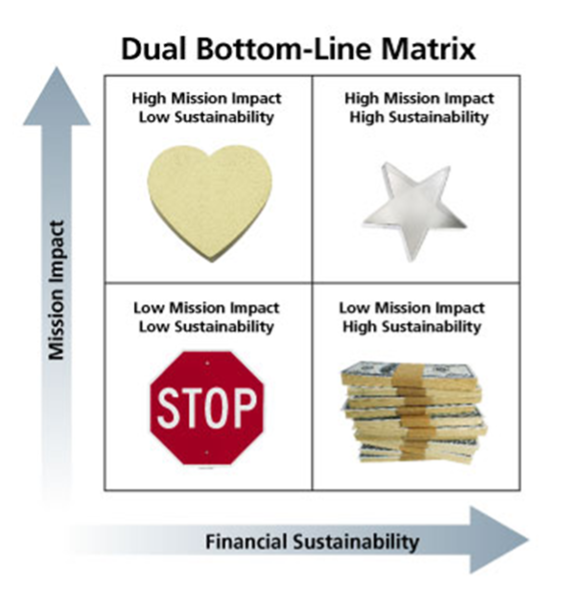
For nonprofits, the challenge is that decisions cannot be made on finances alone. Every program has a dual bottom line: mission impact and financial sustainability. The Dual Bottom-Line Matrix (created by Jeanne Bell and Steve Zimmerman) offers a practical way to evaluate programs through both lenses at once, helping leaders make strategic rather than reactive decisions.
Assess Each Program Honestly
Start by reviewing your organization’s programs and placing each one on a matrix that measures both mission impact and financial sustainability. This can be done by leadership alone, but it is often more useful to have staff and board members complete the exercise separately first, then compare results. Different perspectives can reveal blind spots, hidden strengths, or areas where assumptions are driving decisions more than evidence.
As you discuss the results, ask questions such as:
Which programs most directly advance our mission?
Which programs are financially sustainable, and which depend on recurring subsidy?
Which programs are worth improving, and which may need to be discontinued?
Are there opportunities to redesign a lower-performing program before eliminating it?
The goal is not to label programs as simply “good” or “bad.” The goal is to understand where each program sits in relation to your mission and your resources.

Check Capacity Before Acting
Even when a program looks strong on paper, the organization still has to ask whether it has the capacity to support it. Staff time, board engagement, volunteer support, fundraising bandwidth, and operational systems all affect whether a promising program can succeed. A great idea that stretches the team too far can become unsustainable very quickly.
This is where nonprofit leadership needs discipline. Before making changes, consider whether the organization has the people, processes, and financial margin to implement the decision effectively. In some cases, the right answer is to pause expansion; in others, it is to invest in capacity before expecting stronger outcomes.

Use the Matrix as a Conversation Tool
The real value of the Dual Bottom-Line Matrix is not just in the chart itself. It creates a structured conversation about tradeoffs, priorities, and what success should mean for your organization right now. It is especially helpful when leaders, staff, and board members do not fully agree on what should happen next.
For nonprofit professionals, this kind of framework can reduce emotional decision-making and create a shared language for hard conversations. It also helps organizations move from vague concern to concrete action. Instead of asking only, “Can we afford this?” the better question becomes, “Does this advance our mission, and do we have the capacity to sustain it?”

Move Forward with Intention
Some programs will need to be strengthened. Others may need to be redesigned. And some may need to end, even if they were once important or beloved. The matrix does not make those decisions easy, but it does make them clearer.



Comments